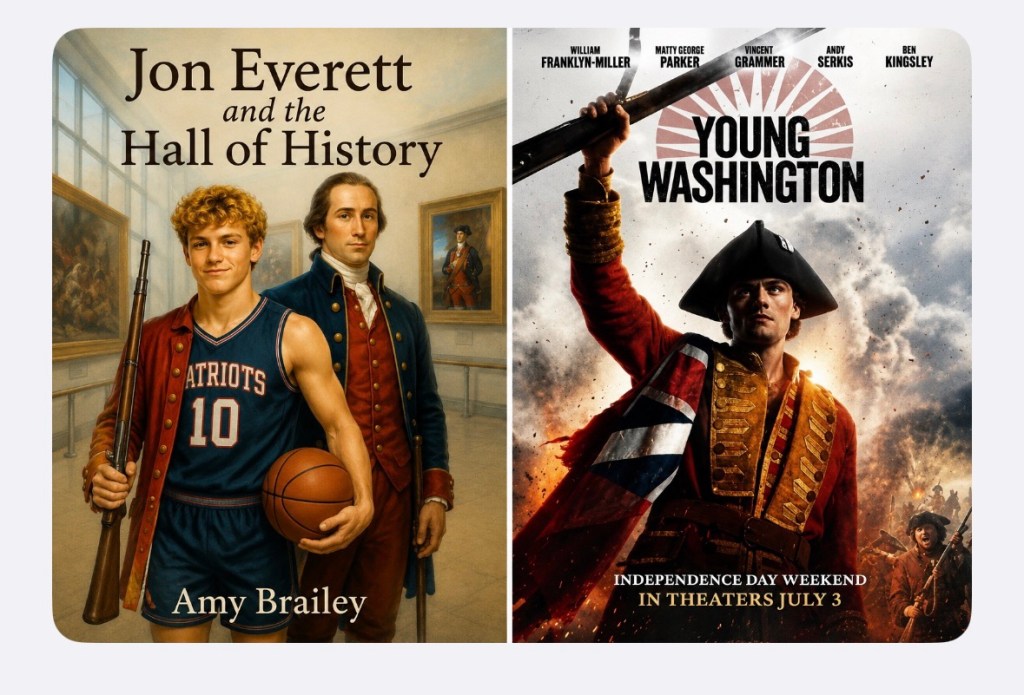
Last night, I had the privilege to see Angel Studio’s Young Washington. This is a movie I’ve looked forward to since I first saw the trailer, as it covers the very time period in George Washington’s life that I cover in Jon Everett and the Hall of History. I was curious to see what they chose to focus on and how it related to what I chose. So, here are my thoughts.
First, overall, I thought the movie was remarkably historically accurate. They focused on many of the same things that I did: Washington’s loss of his father as an eleven-year-old, his ambition, how he was tricked into starting the French and Indian War, quit in disgrace, became a household name, then returned to redeem himself. It is a beautifully told story of loss and redemption, as well as the hand of Providence on George Washington, shaping him for the way our nation would need him. These were the very themes that captured me in the first place and compelled me to write the story in Jon Everett. It’s a story that used to be in history books, since sanitized out because of its focus on God’s protection of Washington, but it’s a story I felt needed to be told.
There were many historical details I LOVED about the movie. Here are a few:
- The Loss of Washington’s father: Washington’s dad Augustine had been married and had four children (two boys survived and had been given land of their own) before he died. (Interesting fact: Augustine had been four when his dad had died and later his oldest son also died, hence the movie line “Washington men die young.”) Augustine remarried, and had six more children, five of whom lived to adulthood. George, the oldest of the five, was eleven when his dad died, removing his financial prospects and making him the man of the house. His half-brother Lawrence helped him a great deal with introductions into society and became a father figure for him. George would inherit Mount Vernon from him.
- Washington sewing his own dress coat. With his poor roots, Washington was consistently looking to advance himself. One thing I found researching him was his interest in fashion–think “The clothes make the man.” He did, in fact, design his own coat and eventually his own uniform. I loved this little detail.
- The trip to Fort LeBoeuf. This trip was extremely dangerous. Both Washington and Christopher Gist fell off a raft in freezing cold water (Gist lost two toes to frostbite). The French responded with great disdain, which was wonderfully portrayed in the movie. (They left out the part where Washington was shot at (and missed) from point blank range by his Native American guide.)
- The Battle of Jumonville Glen. Most people have never heard of this. Washington is enticed by Half-King, who has intense hatred for the French whom he believes are coming to kill him, to go scout a group of French who, unbeknownst to Washington, were there on a diplomatic mission. While there, they end up in a skirmish, resulting in the death of Joseph Coulon de Jumonville, among others. Washington was acting on a threat which wasn’t quite accurate–a fact portrayed very well in the movie, though it makes it not his intent to attack, while other sources say he very much intended to fight. Keep in mind, Washington is 22 at this point.
- The Battle of Monongahela. This is also an unknown battle. George Washington, two weeks out from a bad case of dysentery, managed to lead an incredible retreat, being one of very few officers left alive. He had 2 horses shot out from under him and four bullet holes in his jacket. Sometime after the battle, he met with a detachment of Native Americans. The chief told him he had personally shot at Washington 17 times and ordered all his men to do the same. Thus began Washington’s fame as “The man who would not die.”
As with any movie production (and even Jon Everett), there is always creative license taken and biases embedded. What follows is a list of things that were not accurate to Washington’s own account or other historical records I consulted.
- Romance with Sally: While there are letters in which Washington expresses great ardor to Sally (very different from his “affection” to his wife), Sally was already married when Washington met her. Sally (18), by all accounts, was a flirt, and Washington (16) definitely admired her and called his time in her company the happiest in his life. Still, I don’t see Washington, with his sense of propriety, kissing a married woman. Her husband (not adversarial to Geroge as the movie portrays) became his friend on George’s first surveying experience for Sally’s father-in-law. This voyage was incredibly far, especially when you consider Washington was 16, and took about two weeks. By 17, Washington was a professional surveyor. He maintained a close friendship with both Sally and her husband George, and the Fairfaxes were frequent visitors to Mount Vernon after Washington also married.
- The Death of Christopher Gist: This one almost made me jump out of my seat in the theater. For those unfamiliar, Christopher Gist is the man who accompanied George Washington to Fort LeBoeuf to tell the French to leave the territory. In the movie, Christopher is shot at Fort Necessity, spurring Washington to realize he doesn’t deserve command because it had led to the death of good men. Why that’s my number one complaint is that Christopher Gist is a major character in Jon Everett because he played a HUGE role in the Battle of Monongahela. He was the scout who was sent out and reported back on the Fort’s condition before the attack. From the description of events, he was also to keep an eye on the Native American scouts to make sure their information was accurate. In reality, Christopher died of smallpox in 1759. I feel they could have made the same point with another character.
- Fort Necessity. Washington wasn’t advised not to build there. In fact, he had spent most of his time widening the road. He did realize after construction when it started raining that the fort itself was in shooting range of the trees, so he ordered his men to cut some trees down for breastworks. When the battle arrived, it was raining heavily. Washington went to attack the men in the trees, but the Virginians retreated, leaving only Washington and the regulars, so he ended up retreating to the fort. With both sides suffering from wet gun powder, the French, fearing the British would get reinforcements and knowing their Native American allies were leaving, were the ones to propose a truce, at which time the British raised a white flag to indicate they were ready for negotiations. The French insisted on negotiating in French, which Washington didn’t speak. He sent a Dutch friend who apparently understood the gist of it, and told Washington it was okay. He translated “Assassinated” as “Killed.”
- Washington neither asked for the messenger job nor to be Braddock’s Aide-de-Camp. While the movie makes it this way to play into his ambition, his skills as a surveyor and his brother’s recommendation got him the first office, and Braddock’s knowledge of Washington from his account of his trip to Fort LeBoeuf had made him a household name. Braddock had his Aide-de-camp Robert Orme send Washington a letter, which he joyfully accepted.
- Tension between Washington and Gage. Good, though, Gage was an excellent leader and had led the advanced guard of the mission. While he and his men did retreat, those were Braddock’s orders (The movie says they’re Gage’s), and since Gage’s men were the advanced guard, they would have been the last to get back, not the first ones running away with Washington’s men on the front lines as the movie portrays. Additionally, I’m sure many men just fled on their own, necessitating a retreat. The French commander was killed in the opening volley, leaving the French in confusion since they had no leader, and leaving the Native Americans with no one to restrain them, so they went on a scalping spree. Crazy.
- Braddock’s wounding. Braddock was shot through the arm into his lung, so he could no longer give orders. Washington took over the retreat, carrying messages and moving troops. Braddock didn’t die there, nor was he left. Washington made sure he got back to camp, where he would die four days later. He did give Washington his sash and pistols. George Washington had him buried in the road and had the whole army march over the spot to obscure it so the Native Americans wouldn’t desecrate his body. He was lost to history until the early 1800’s when workers putting in a road discovered the body and moved it to where the monument is today. There’s a plaque in the road where the body was originally buried.
Overall, it was an excellent movie, and the good definitely outweighed the things I would have done differently or more historically. If you’re interested in learning more about this time period, I’d definitely recommend visiting Braddock’s Battlefield History Center, Fort LeBeouf, Fort Necessity National Battlefield, The Fort Pitt Museum, and Jumonville Glen. Also, the book Braddock Road Chronicles 1755 was an amazing resource for me when I was preparing Jon Everett. It has first hand accounts, letters, newspaper articles, etc, from the time. Washington’s own account in The Journal of Major George Washington, sent by the Hon. Robert Dinwiddie, Esq.; His Majesty’s Lieutenant Governor, and Commander in Chief of Virginia, to the Commandant of the French Forces on Ohio. To Which Are Added, the Governor’s Letter; and a Translation of the French Officer’s Answer is also a good read, Yes, short titles were not his thing…


 Books by Brailey and Not Lost Prints
Leave a comment